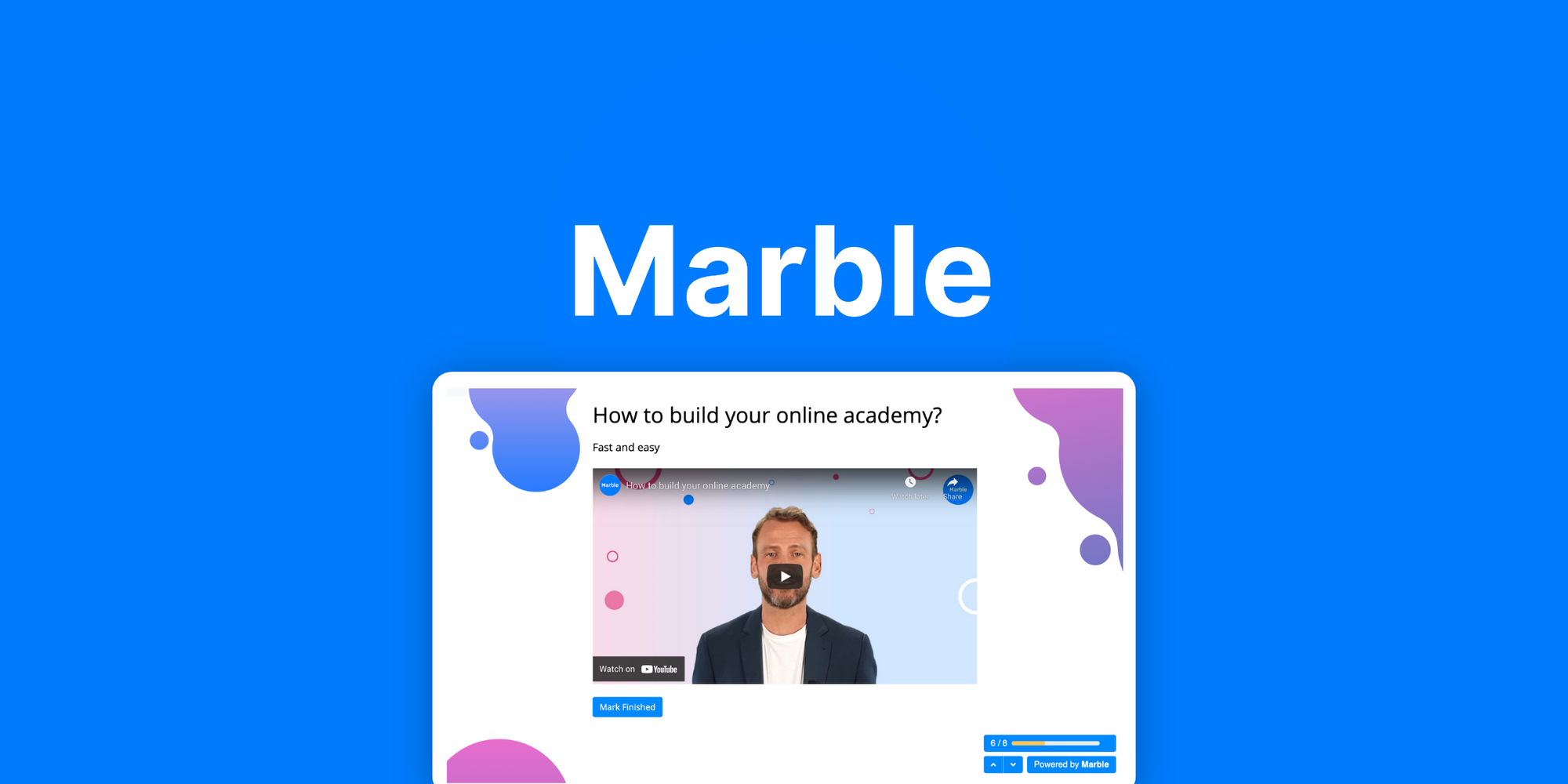
MarbleBuild It Yourself Analysis
“Don't build another generic LMS; build the simplest one for music teachers and internal trainers.”
Worth Studying
Demand appears real and the incumbent looks vulnerable enough to justify deeper validation.
Worth Studying
Demand appears real and the incumbent looks vulnerable enough to justify deeper validation.
Medium-High
Based on revenue, reviews, strategy fit, and visible downside signals in the current dataset.
AppSumo-first signal
This tells you how much of the current read is supported by strong in-platform evidence versus thin or ambiguous signal.
Verify that the workflow users want is valuable enough to stand alone outside the suite.
Builders who want to strip one high-value workflow out of a bloated suite and sell simplicity.
Teams that plan to copy the entire incumbent and compete feature-for-feature.
Lifetime deal with unlimited usage is a long-term scalability risk. The course platform market is saturated; differentiation via deep niche focus is critical to survive.
Revenue and review volume suggest this market is real.
There are early signs of friction, but not enough to call it a strong wedge.
There is some willingness to pay, but pricing power is not yet obvious.
There may be a wedge here, but the competitive gap is still ambiguous.
Still needs off-platform confirmation from search demand, communities, or customer interviews.
“They want to launch and monetize a course in minutes, not weeks, and are overwhelmed by feature-bloated alternatives.”
Lifetime deal with unlimited usage is a long-term scalability risk. The course platform market is saturated; differentiation via deep niche focus is critical to survive.
The 4-Dimension Scorecard
Medium revenue ($42k) from 87 reviews shows solid early adoption, but not yet a breakout hit.
High rating (4.71) indicates strong user satisfaction, but the review volume (87) is not a massive barrier to entry yet.
Lifetime deal with unlimited learners/creators poses long-term cost risks, but course platforms have lower variable costs than AI/API-heavy tools.
Competitors are established, complex platforms (Kajabi, Podia, Thinkific). Simplicity is a wedge, but the space is crowded.
The Opportunity Radar
Deep Review Mining & Gap Analysis
Pain & Gaps
"Users love the simplicity but feel constrained by the lack of branding and layout options."
"A review hinted at embedded content being downloadable; users want DRM or secure hosting."
"Explicit complaint about poor support; users expect faster help when launching paid courses."
Niche Discovery
"Explicit review: 'Great For Music Teaching! Finally — an LMS that I will actually be able to use regularly!'"
"Review: 'Using for internal training' indicates a need for simple, private employee onboarding."
"Multiple reviews praise simplicity for 'small players' and getting to revenue fast."
Marketing Angle
The only LMS built specifically for [Music Teachers/Internal Trainers] who value speed over endless features.
Use this angle to position your product against the generic competitors. Focus on the specific pain points identified in the "Pain & Gaps" module.
Counter-Signals
Reasons this opportunity may look better in the dataset than it will feel in the real market.
- Lack of customization, poor support, and fears of outgrowing the platform as their needs become more complex.
Sniper Verdict
“Listen to the hate. Build the cure. Steal the revenue.”
Execution Plan
“Marble proves the market craves simplicity, but its one-size-fits-all approach leaves niches underserved. By cloning its core 'simplicity first' logic and applying it to a specific vertical like music education, we can own a defensible segment.”
Build First
- Niche-specific course templates (e.g., 'Music Lesson Progression', 'Employee Onboarding Checklist') - drastically reduces setup time for the target audience.
- Built-in tools for the niche (e.g., tuner/metronome embed for music, compliance quiz for corporate) - becomes the obvious choice.
Do Not Start With
- Advanced customization dashboard for general users - a distraction that adds complexity.
- Broad third-party integrations - start with 2-3 key integrations for the niche (e.g., Spotify for music, Slack for corporate).